
Server vs Web Hosting is one of the most common questions beginners ask when launching their first website.
Imagine you’re launching your first website.
You start researching hosting solutions and suddenly come across terms like web hosting, VPS hosting, dedicated servers, cloud servers, and web servers.
At this point, many beginners ask the same question:
“What’s the difference between a server and web hosting?”
The confusion is understandable because people often use these terms interchangeably.
However, they are not the same thing.
Understanding the difference between Server and Web Hosting is important because it helps you choose the right infrastructure, avoid overspending, and ensure your website performs well as your business grows.
In this guide, we’ll explain everything in simple language so that even complete beginners can understand the difference.
Server vs Web Hosting: Quick Explanation
A server is a powerful computer that stores, processes, and delivers data.
Web hosting is a service that gives you access to server resources so your website can be available online.
Think of it this way:
- Server = The Building
- Web Hosting = Renting a Room Inside That Building
The building exists whether you rent a room or not.
Similarly, servers exist whether you purchase hosting or not.
Web hosting simply allows you to use server resources without managing the entire server yourself.
What Is a Server?
A server is a high-performance computer designed to provide services, applications, files, or websites to other computers over a network.
Unlike a regular desktop computer, servers are built to:
- Run 24/7
- Handle multiple users simultaneously
- Process large amounts of data
- Deliver websites and applications quickly
- Provide stable performance
Servers are commonly used for:
- Websites
- Business applications
- Databases
- Email services
- Cloud platforms
- Remote Desktop (RDP)
- Game hosting
- Video streaming
- Video encoding
Many VPS and dedicated servers run operating systems such as Ubuntu Server and Windows Server.
What Is Web Hosting?
Web hosting is a service that allows individuals and businesses to publish websites on the internet.
When you purchase a hosting plan, you’re essentially renting resources from a server managed by a hosting provider.
The hosting company takes care of:
- Server hardware
- Network connectivity
- Security
- Maintenance
- Backups
- Uptime monitoring
This makes web hosting an excellent option for beginners who want to launch a website without learning server administration.
Many websites built with WordPress start with web hosting because it’s simple, affordable, and beginner-friendly.
Real-Life Example:
Imagine you want to open a retail store.
Option 1: Rent a Shop
You rent a ready-to-use shop inside a commercial building.
The building owner handles maintenance, security, electricity, and infrastructure.
This is similar to web hosting.
You simply use the space and focus on running your business.
Option 2: Buy the Entire Building
You purchase the whole building.
Now you control everything, but you’re also responsible for maintenance, security, upgrades, and management.
This is similar to having your own server.
You gain maximum control but also take on greater responsibility.
Why This Difference Matters:
Many beginners assume web hosting and servers are the same thing.
Understanding the difference helps you:
- Avoid paying for resources you don’t need
- Choose the right hosting plan
- Improve website performance
- Scale your business efficiently
- Plan future upgrades
As your website grows, this knowledge becomes increasingly important.
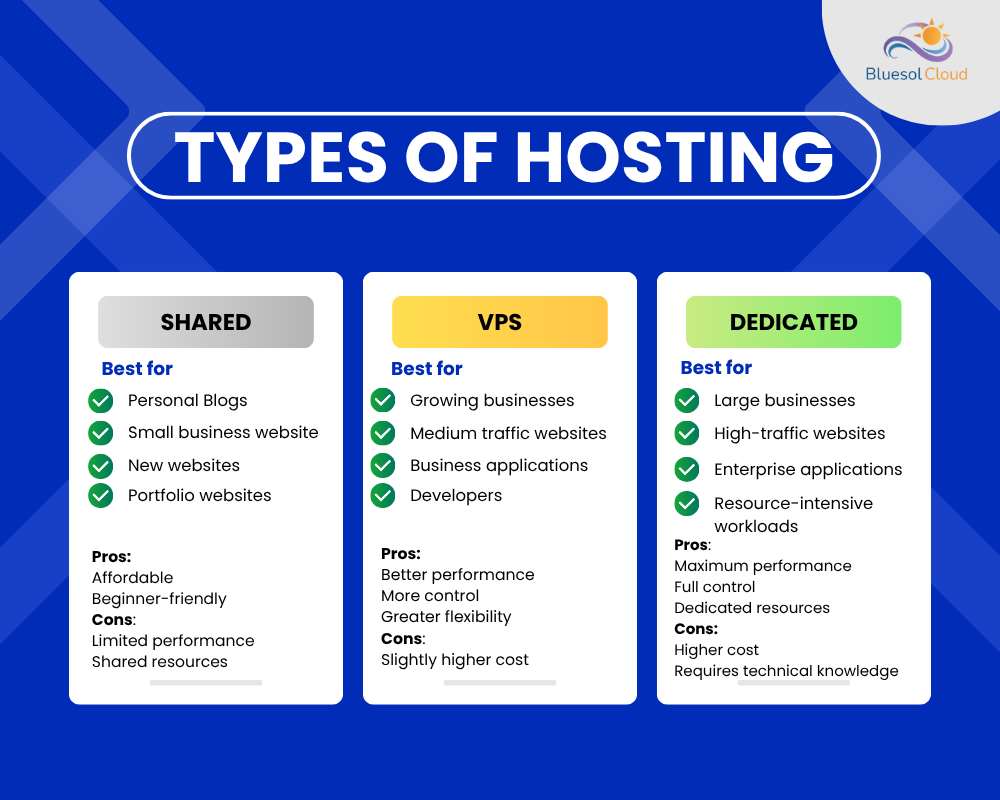
Types of Web Hosting:
Not all hosting solutions are the same.
Let’s look at the most common options.
1. Shared Hosting
Multiple websites share the same server resources.
Best for:
- Personal blogs
- Small business websites
- New websites
- Portfolio websites
Pros:
- Affordable
- Beginner-friendly
Cons:
- Limited performance
- Shared resources
2. VPS Hosting:
A physical server is divided into multiple virtual servers.
Each VPS receives dedicated resources and operates independently.
Best for:
- Growing businesses
- Medium-traffic websites
- Business applications
- Developers
Pros:
- Better performance
- More control
- Greater flexibility
Cons:
- Slightly higher cost
3. Dedicated Server Hosting:
A single customer receives an entire physical server.
Best for:
- Large businesses
- High-traffic websites
- Enterprise applications
- Resource-intensive workloads
Pros:
- Maximum performance
- Full control
- Dedicated resources
Cons:
- Higher cost
- Requires technical knowledge
4. Cloud Hosting:
Cloud hosting distributes resources across multiple servers.
Best for:
- Scalability
- High availability
- Growing businesses
Pros:
- Flexible
- Reliable
- Scalable
Cons:
- Pricing can vary
What Can You Actually Control?
One of the biggest differences between web hosting and servers is the level of control you receive.
| Feature | Shared Hosting | VPS Server | Dedicated Server |
|---|---|---|---|
| Root/Admin Access | No | Yes | Yes |
| Install Custom Software | No | Yes | Yes |
| Change Server Settings | No | Yes | Yes |
| Run MT4 / MT5 | No | Yes | Yes |
| Create System Users | No | Yes | Yes |
| Full Hardware Control | No | No | Yes |

For most beginners, this is the easiest way to understand the difference. The more control you need, the closer you move from shared hosting toward VPS and Dedicated Servers.
Server vs Web Hosting Comparison:
Here’s a quick comparison of Web Hosting, VPS Servers, and Dedicated Servers:
| Feature | Web Hosting | VPS Server | Dedicated Server |
|---|---|---|---|
| Cost | Low | Medium | High |
| Control | Limited | High | Full Control |
| Performance | Basic | Better | Maximum |
| Technical Skills Required | Low | Medium | Advanced |
| Scalability | Moderate | High | Very High |
| Best For | Beginners | Growing Businesses | Enterprise Workloads |
When Should You Choose Web Hosting?
Web hosting is usually enough if you:
- Run a blog
- Have a company website
- Need a portfolio website
- Have low to moderate traffic
- Want a simple solution
For most small businesses, web hosting is the easiest and most affordable starting point.
When Should You Choose a VPS Server?
Consider a VPS server if:
- Your website traffic is growing
- You need better performance
- You want root access
- You host applications
- Shared hosting feels limiting
A VPS provides significantly more flexibility without the cost of a dedicated server.
When Should You Choose a Dedicated Server?
A dedicated server is ideal when:
- Performance is critical
- You host multiple websites
- You run business applications
- Security is a priority
- You require maximum control
Dedicated servers provide predictable performance because all resources belong exclusively to you.
Why Businesses Are Moving Toward VPS and Dedicated Servers:
As websites grow, shared hosting often becomes a bottleneck.
Common issues include:
- Slow loading speeds
- Resource limitations
- Traffic restrictions
- Limited customization
- Performance inconsistencies
This is why many businesses eventually upgrade from shared hosting to VPS hosting or dedicated servers.
The additional control and performance often justify the increased cost.
Common Myths About Servers and Hosting:
Myth 1: Hosting and Servers Are the Same Thing
Not exactly.
Hosting is a service that provides access to server resources.
Myth 2: Every Website Needs a Dedicated Server
False.
Many successful websites start with shared hosting or VPS hosting.
Myth 3: Dedicated Servers Are Only for Large Enterprises
Not anymore.
Today, dedicated servers are affordable for growing businesses, agencies, developers, and e-commerce websites.
Frequently Asked Questions:
1. Is web hosting a server?
No. Web hosting is a service that provides access to server resources.
2. Which is better, hosting or a server?
Neither is universally better. The right choice depends on your requirements and budget.
3. Can I host my website on a dedicated server?
Yes. Many businesses host websites on dedicated servers for maximum performance and control.
4. Is VPS better than shared hosting?
For most growing websites, VPS hosting provides better performance, flexibility, and scalability.
5. Do beginners need a dedicated server?
Usually not. Most beginners can start with web hosting or VPS hosting.
6. What is the biggest advantage of a dedicated server?
Complete control over hardware resources and server configuration.
7. Can I start with web hosting and upgrade later?
Yes. Many businesses begin with web hosting and later upgrade to VPS hosting or dedicated servers as traffic and resource requirements increase.
Conclusion:
Understanding Server vs Web Hosting helps businesses choose the right infrastructure.
Web hosting is ideal for beginners and small websites because it’s simple, affordable, and easy to manage.
Servers—especially VPS servers and dedicated servers—provide greater performance, flexibility, and control for businesses that need more power.
As your online presence grows, upgrading from shared hosting to VPS hosting or a dedicated server can help improve speed, security, and reliability.
If you’re considering a virtual server, be sure to read our What Is a VPS Server? Complete Beginner’s Guide (2026) to learn how VPS hosting works and whether it’s the right choice for your business.
At BluesolCloud, we help businesses choose the right server solutions based on their performance requirements, budget, and long-term growth goals.
One Response
Great article! The comparison between a server and web hosting is explained in a very simple and beginner-friendly way. I especially liked the building and room analogy, as it makes the concept easy to understand. The content is well-organized, informative, and helpful for anyone new to web hosting.