

If you’re looking for a powerful hosting solution, you’ve probably come across two popular options: VPS servers and Dedicated Servers.
At first glance, they may seem similar because both offer better performance and control than traditional shared hosting.
However, they are designed for different needs.
Choosing the wrong option can lead to unnecessary costs, performance limitations, or future scalability problems.
In this guide, we’ll explain the differences between VPS and Dedicated Servers in simple language, helping you choose the right solution for your website, application, or business.
VPS vs Dedicated Server: Quick Explanation
A VPS (Virtual Private Server) is a virtual environment created inside a physical server.
A Dedicated Server is an entire physical server assigned to a single customer.
Think of it like this:
- VPS Server = Owning a private apartment in a large building
- Dedicated Server = Owning the entire building
Both provide privacy and control, but a Dedicated Server offers complete ownership of all resources.
What Is a VPS Server?
A VPS server is created using virtualization technology.
A powerful physical server is divided into multiple virtual servers, and each VPS receives its own:
- CPU allocation
- RAM allocation
- Storage
- Operating System
- Network resources
This allows users to enjoy many benefits of a dedicated server without paying for an entire physical machine.
Internal Link Opportunity: Link What Is a VPS Server to your VPS article.
What Is a Dedicated Server?
A Dedicated Server is a physical server assigned exclusively to one customer.
Unlike VPS hosting, no resources are shared with other users.
You receive complete access to:
- CPU resources
- RAM
- Storage
- Network bandwidth
- Server configuration
This makes dedicated servers ideal for businesses that require maximum performance, security, and reliability.
If you’re new to server infrastructure, IBM’s server guide explains how servers work and why businesses use them for websites, applications, and databases.
Real-Life Example:
Imagine you need office space for your business.
VPS Server
You rent a private office inside a commercial building.
You have your own workspace and resources, but the building is shared with other businesses.
Dedicated Server
You purchase the entire building.
Everything belongs to you.
You decide how resources are used, how security is managed, and how the building is configured.
This is the biggest difference between VPS and Dedicated Servers.
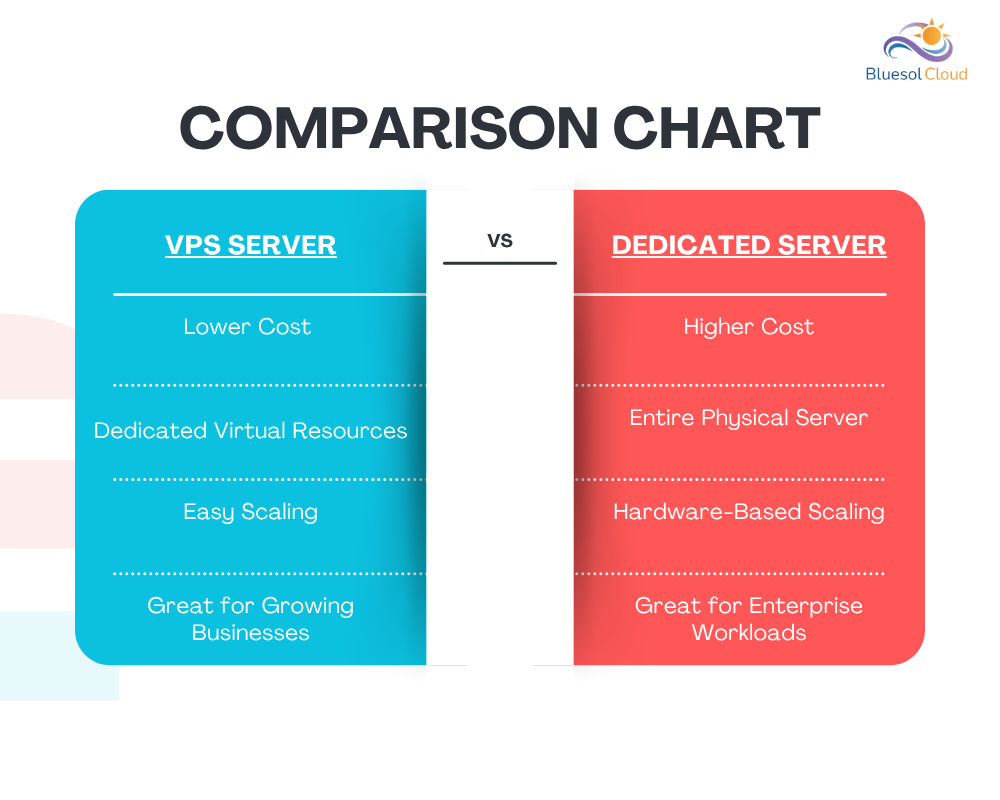
VPS vs Dedicated Server Comparison:
Many businesses compare VPS vs Dedicated Server solutions before choosing their long-term infrastructure.
| Feature | VPS Server | Dedicated Server |
|---|---|---|
| Cost | Lower | Higher |
| Performance | High | Maximum |
| Resource Isolation | Strong | Complete |
| Scalability | Easy | Hardware Dependent |
| Customization | High | Full Control |
| Security | Excellent | Maximum |
| Maintenance | Easier | More Advanced |
| Best For | Growing Businesses | Enterprise Workloads |
Admin Access and Server Control:
Many beginners compare VPS vs Dedicated Server based on performance, but control is equally important.
| Feature | VPS Server | Dedicated Server |
|---|---|---|
| Admin Access | Yes | Yes |
| Install Software | Yes | Yes |
| Create User Accounts | Yes | Yes |
| Configure Security Settings | Yes | Yes |
| Full Hardware Control | No | Yes |
| Custom Hardware Selection | No | Yes |
A VPS Server gives you full control over your virtual environment, while a Dedicated Server gives you control over the entire physical machine.
Performance Comparison:
Performance is one of the biggest reasons businesses upgrade from shared hosting.
VPS Performance
A VPS receives dedicated virtual resources.
For most websites, applications, and business workloads, VPS performance is more than sufficient.
Dedicated Server Performance
A Dedicated Server provides access to all physical resources.
There is no virtualization overhead and no resource sharing.
This makes dedicated servers ideal for:
- Large databases
- Enterprise applications
- High-traffic websites
- Streaming platforms
- Resource-intensive workloads
Cost Comparison:
For many businesses, budget plays a major role.
VPS Server
Advantages:
- Lower monthly cost
- Flexible upgrades
- Excellent value for money
Best for:
- Small businesses
- Startups
- Developers
- Growing websites
Dedicated Server
Advantages:
- Maximum resources
- Predictable performance
- Complete control
Best for:
- Large businesses
- Enterprise applications
- High-traffic platforms
If budget is important, VPS hosting is often the better starting point.
Security Comparison:
Both VPS and Dedicated Servers can be highly secure.
VPS Security
Modern VPS environments provide strong isolation between users.
Most businesses find VPS security more than adequate.
Dedicated Server Security
Dedicated Servers provide complete resource isolation because no other customers share the machine.
This can be beneficial for businesses with strict compliance or security requirements.
Scalability Comparison:
VPS Server
One of the biggest advantages of VPS hosting is scalability.
Resources can often be upgraded with minimal downtime.
You can easily increase:
- RAM
- CPU
- Storage
as your business grows.
Dedicated Server
Dedicated Servers are scalable, but upgrades may require hardware changes or migrations.
For rapidly growing businesses, VPS solutions can sometimes be more convenient.
When Should You Choose a VPS Server?
A VPS server is a great choice if:
- Your website has outgrown shared hosting
- You need better performance
- You require root access
- You run trading software
- You host business applications
- You want a cost-effective solution
Many growing businesses find that VPS hosting provides the perfect balance between performance and affordability.
When Should You Choose a Dedicated Server?
A Dedicated Server is ideal if:
- Performance is mission-critical
- You host multiple high-traffic websites
- You run enterprise applications
- You need maximum security
- You require full hardware control
Dedicated Servers are often used by larger businesses that need guaranteed resources.
Common Use Cases:
VPS Server Use Cases
- Website hosting
- Forex trading
- Remote Desktop (RDP)
- Application hosting
- Development environments
- Small streaming projects
Internal Link Opportunities:
- Forex VPS
- Streaming VPS
- Windows VPS
- Linux VPS
Dedicated Server Use Cases:
- Enterprise websites
- Large databases
- Video streaming platforms
- SaaS applications
- High-performance workloads
- Multi-client hosting environments
Common Myths About VPS and Dedicated Servers:
Myth 1: Dedicated Servers Are Always Necessary
False.
Most businesses perform perfectly well on VPS hosting.
Myth 2: VPS Hosting Is Only for Small Websites
False.
Many successful businesses run entirely on VPS infrastructure.
Myth 3: Dedicated Servers Are Too Expensive
Not necessarily.
Modern dedicated servers are more affordable than they were a few years ago.
Frequently Asked Questions:
1. Which is better: VPS vs Dedicated Server for a growing business?
Not necessarily. VPS is more affordable, while Dedicated Servers provide maximum performance and control.
2. Which is faster, VPS or Dedicated Server?
Dedicated Servers are generally faster because all resources belong to a single customer.
3. Is VPS enough for a business website?
For most small and medium-sized businesses, yes.
4. When should I upgrade from a VPS to a Dedicated Server?
Consider upgrading when resource requirements consistently exceed your VPS capabilities.
5. Is a Dedicated Server more secure than a VPS?
Dedicated Servers offer complete isolation, and both options can be highly secure when properly configured.
6. Can I start with a VPS and upgrade later?
Yes. Many businesses begin with VPS hosting and move to Dedicated Servers as they grow.
Conclusion
Understanding the differences between a VPS Server and a Dedicated Server can help businesses avoid unnecessary costs and choose the right infrastructure.
Choosing between a VPS and a Dedicated Server depends on your performance requirements, budget, and growth plans.
A VPS Server offers an excellent balance of affordability, flexibility, and performance, making it ideal for most growing businesses.
A Dedicated Server provides maximum resources, complete control, and predictable performance for demanding workloads.
If you’re still deciding, start by understanding your current resource requirements and future growth expectations.
You may also find these guides helpful:
- Server vs Web Hosting: Key Differences Explained (2026)
- What Is a VPS Server? Complete Beginner’s Guide (2026)
At BluesolCloud, we offer both VPS and Dedicated Server solutions designed to help businesses scale with confidence.